Thứ Ba, 17 tháng 7, 2012

"Duck de Chine" or Beijing Duck?


No, it's not a spelling mistake, but the name of a top-level restaurant in Beijing serving Beijing duck but with innovative French cooking techniques, another kind of East-West fusion.

The front entrance has Chinese elements for sure...terracotta warriors, tiled roof, long life (bat) designs on the wall.

As soon as you go in, you feel the peaceful environment of a traditional courtyard.


 Everything is laid out ready for a refreshing cup of Chinese tea.


There are of course ducks all over the place...sitting in a row, head to head in the pattern of the floor tiles....


..as graceful mandarin ducks hanging on the wall..........
..or not looking so happy as they hang ready for roasting.
The restaurant chooses large meaty five pound ducks from near Beijing, and roasts a few hundred a day. With each duck costing USD 40, you can see there's quite a cashflow going through the place! The chef may look young but he's been at this job since he was 15 years old!
Note the traditional oven using date wood logs for firewood. 
Half way through, the duck has to be taken out and basted with special stock.
While all this is going on in the kitchen, the condiments and mixture of three sauces have been laid on the table.

We start off with some other dishes...walnuts, lamb and Chinese broccoli....

and finally the chef proudly brings out the golden coloured duck and starts slicing it in the traditional way, separating the crispy skin from the tender meat.
The meal is complete with thin pancakes and sesame buns. Absolutely yummy!
Bon Appetit! 


Thứ Tư, 11 tháng 7, 2012

Taking Gifts to China

Clients are always asking me about what gifts to take with them to China. It all depends on the circumstances. Gifts for hosts are different from gifts for guides or for children. A gift for a host family or friends should be useful and fairly inexpensive as your host or friend may be obligated to return the favor with like value. Perhaps something that represents your area and should be something useful rather than decorative. Be careful that it may read somewhere on it that it is 'Made in China" like so many products these days. For children wrapped candy is good but should be something from your country and not available in China like from the U.S. Tootsie Rolls and fruit Life Savors are well received. For guides or service people, I like to use the new U.S. $1.00 gold colored coins. Gold is symbol of wealth and many Chinese are avid collectors of coins. Otherwise pens, caps with your local baseball or football team emblem on it and other small items are good too. DO NOT give anything that cuts like knives, scissors, razor blades etc. That is a symbol of wanting to cut the relationship off. Do not give any watches or anything that keeps time.....as it is a symbol for a short life. When wrapping it in paper, make sure it is either red or gold paper. Red is the symbol of Good Luck and gold is the symbol of Wealth. Never wrap anything in white paper as it is the symbol for death. Many Chinese are superstitious so it is wise to think of this when purchasing gifts. For more information on travel in China read other blog stories or contact us at interlak@eskimo.com

Thứ Ba, 10 tháng 7, 2012

Laundry in China

As a Tour Operator to China going into my 25th year, I am asked many questions before clients leave on their tour. Although I have a very large tour packet of information I am also glad to answer specific questions. Laundry is covered in the packet but I still get many questions about it. In the cities with most hotels, there is a laundry list in your hotel. Laundry generally left in the morning is returned by evening. Special fast service is available at a 50% additional charge. Laundromats as we know them are almost non-existent. Prices can be expensive and are generally more in 4 and 5 star hotels. A pair of jeans can be as much as $5. Socks, underwear and other small items can often be washed in your room and hung up to dry. Synthetic materials dry much faster than cotton. Synthetic shirts, pants and skirts can be washed, rung out and rolled up in a towel to absorb water and later hung up and are often dry by morning. For more money saving tips, contact us for your specific interests. interlak@eskimo.com

Thứ Bảy, 30 tháng 6, 2012

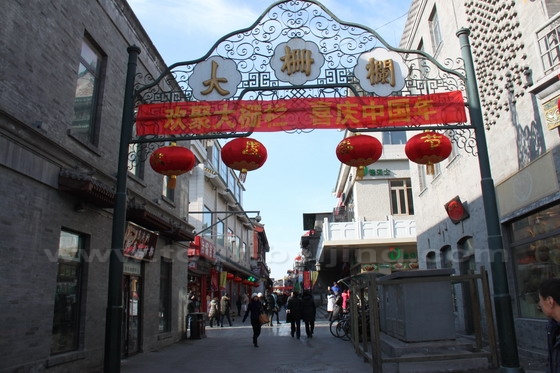
A Busy Shopping Street full of History, Culture and Character

Many people come to Beijing to shop for souvenirs. If you're looking for a quiet hutong with boutique shops to wander through, then see our blog of July 26, 2009. If you're looking for gleaming new shopping malls full of Western name brands, then they are everywhere, and great for cooling off or finding a clean toilet. If you like to bargain, then there are all sorts of markets, see blogs of 15 July 2009, Mar 2010, Nov 2010, Dec 2011......

However, if you want to see a bustling shopping street full of history, culture and character, then just head off a few steps from the renovated Qian Men Street. This street, almost 300 m long, has been here for 600 yrs, and lived off the wealthy royals and court people living in and around the nearby Forbidden City. It has been burnt down several times through fire and fighting but still remains a popular commercial area. Over 100,000 people pass through every day!

The best silks, shoes, hats, foodstuff can all be bought here. It was the original pedestrian street of Beijing, and full of old Chinese brands, many of which are sadly no longer famous.  

Starting at the western end of the street you will soon pass by the first cinema in China, (1907) which was a tea house originally for watching Beijing Opera, and now
turned into a cafe. 
Silk was invented in China so naturally there are several famous silk stores along this street. This display shows the basics of spinning, dyeing and weaving.


This store proudly shows off the first Chinese flag of the People's Republic of China they made, which was used in Tiananmen Square during the Oct 1st independence day celebration in 1949.


The Rui Fu Xiang silk store is housed in a magnificent buidling with western columns and carved Chinese floral designs.

You are given a friendly greeting outside the Bu Ying Zhai shoe store which makes high quality handmade shoes of all designs traditional and modern.
This silk store next door also has wonderful 19th century (Qing) wrought iron facade, a bit like the mansions in Penang (Apr 2012 blog), as well as stone carved walls..


One shop still famous after all these years is Liu Bi Ju, meaning Six Daily Necessities, referring to “firewood, rice, oil, salt, sauce and vinegar”. Based on that business, the shop is still famous for its wide variety of tasty pickles.


Across the road is a newly developed are called Xian Yu Kou or Fresh Fish Mouth, where you can sample all sorts of local food from around China, including also a Taiwan Street behind. When we were there, there was a beautiful display of different lights showing various folk characters and gods.


Looks like the Monkey King?


God of Longevity with his long life peaches

And you may recognise this Westernized God....

Many local snacks can be found, including these noodles being shaven in strips off a lump of dough, "dao xiao mian"

and the ever popular "jian bing", a kind of savoury pancake.

Further on, you will see a local fruit and vegetable market....

strawberries for USD2 per pound.

all kinds of dried fruits, such as we have seen in Xinjiang...

different spices and herbs

can you see what these are?


more familiar vegetables


So many different vegetables...it would take another morning to show you round a local market. If there are any foodies out there, I would love to take you round, buy some fresh ingredients you like and then come to my home to make dumplings...... ready when you are!

Thứ Tư, 27 tháng 6, 2012

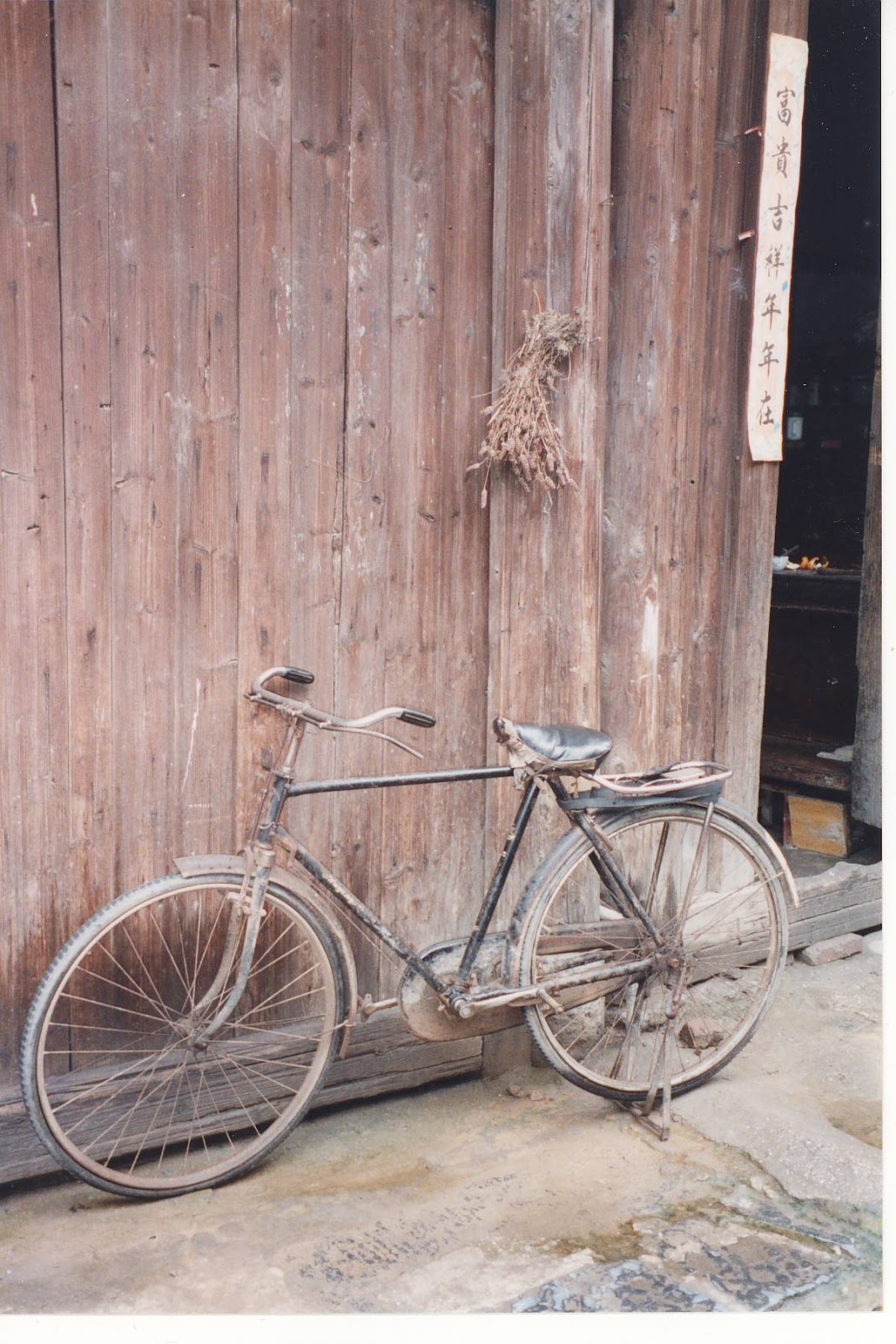
Where Have All the Bicycles Gone?


These photos are from a by gone past just 15 years ago.   Today, the millions of bicycles that we use to see are now mostly replaced by cars as well as millions of motor scooters and motorized bikes that we refer to as Mopeds. Someone riding a bicycle in Beijing is now rare. I walked 5 blocks down a main street in Beijing and only counted 5 pedal bicycles this past year, where one just 15 years ago could have counted hundreds. Gone are the bike parking areas like you see here replaced by scooter parking lots. More Pollution? Probably but most of them are run by battery.  When the battery starts to wear down they just pull into a station and swap it out for a charged one.  One can lease a battery rather than needing to buy one and there is no charging time.  Pictured here is an old bike from the 1980's which could have been bought for just $12 U.S. back then as one of the standard means of transportation. Be Warned however, the battery operated scooters and Mopeds run silent and one needs to watch out when crossing streets.   For more information on Travel in China contact me via email at  Interlak@eskimo.com   This year will be my 25th year of travel in China and over 50+ trips through out the country as a Tour Operator to China and Tibet.
Chủ Nhật, 24 tháng 6, 2012

Which One is Your Buddha?


In China you will always find something interesting including some Temples.  The Temple here was a new one I discovered in the countryside one day.  The Temple is round and contains statues of over 100 Buddhas.  There are four entrances to the Temple.  The idea is that you may go in any entrance that you wish.  You then turn to the right and then start counting  Buddhas until you get to your age and that is your Buddha.  Being a bit heavy at 230 lbs, the Buddha at my age is pictured here and was quite realistic and my Chinese friends had a good laugh about it with me.  A well planned tour can give you many experiences and wonderful memories of a visit to China.   We have been doing tours to China for almost 25 years and I personally work with my local Chinese associate partners developing great tours and checking sights and hotels to insure excellent tours to my customers needs and wants.   Check out our web site at www.interlakechinatours.com    Private customized tours to your interests are our specialty.  You may only go to China once in your life so you might as well see what you are interested in since you can't see everything in just one trip.  Over 25% of our customers go back again and we hope you will be one of them.  

Thứ Bảy, 9 tháng 6, 2012

China Tour Prices

I teach a class here in Seattle on Saturdays one day a quarter on Travel in China.  As a tour operator I understand how difficult it is to compare tours and find out which one is the best value as well as a good tour.  Travel is expensive today so most people want to compare tours but many people really do not understand the difference in costs.  Hotels in the central area are best for tourists so they can freely walk around and see sights during their free time.  Some tour companies put people either in the suburbs or neighborhoods outside the central area which are cheaper but very inconvenient as you must take a taxi every time you want to leave.  The cost difference and time spent is not worth the savings but it makes the tour company look good with the lower cost. The best way to compare tours is contacting the tour company and asking for a reference list of former customers so you can get an independent assessment of their tours.  You get what you pay for in China.  There are deluxe tours and budget tours and your budget needs to be met as well.  5 star hotels have a wide range in China in costs.  The best values are 4 star hotels.  Within the hotels there are rooms usually at 4 or 5 different levels in cost.  Tour operators generally book the cheapest of course unless you are on a private tour and request a Superior or Deluxe room.  For more information contact us with your questions.  We are always glad to give you advice whether you are a customer or not.  Email me at
interlak@eskimo.com     Our web site is  www.interlakechinatours.com   Our 25th Year of China only.

Bài đăng phổ biến